
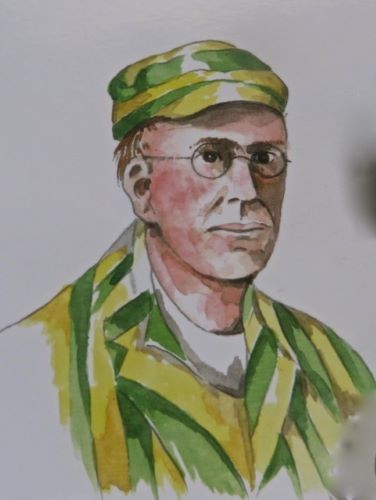
Over the past few months, we have lost a few cricketers that I played with and against. As we get older, I often reflect on the good times, especially on how different it is these days. I always associate Christmas with the death of Willie Andrews, a Colossus of Irish cricket who died on 22nd December 1966. He was eighty when he passed, and anyone who met him has their own story of an incredible character. I’m no different.
I first met ‘Big Willie’ when I was nine. He was a huge man, gault with a squeaky voice, and ruled the roost of the club and the Union. Few questioned his opinion.
I played cricket and football from dawn to dusk, and our Green was much smaller than ‘The Green’ as it was in front of my home at our housing estate. I didn’t appreciate at the time, but I was blessed with a cricket heritage if not a cricket pedigree as none of my family were cricketers. After all, North Down Cricket Club was a founder member of the Northern Cricket Union, whose contribution to Irish cricket on and off the field, was unsurpassed. I grew up weaned on the stories of the North Down ‘greats’ for over fifty years. I often stood in awe at the old wooden floor of the Clubhouse looking up and down at the old framed photographs of those moustache heroes of yesteryear. All the photos were set alongside with huge trophies. As I’ve now reached 76, I am still in awe of what our club has achieved over the years, and my small part in its history. However, it pales in comparison to William Andrews, perhaps the most eccentric cricketer in Irish cricket. In Wisden 1967 it was said… “He was the Grand Old Man of Irish Cricket.”
Born at Ardara House, Comber into privilege on 25 August 1886. Willie’s passion in his life was cricket. He was an avid collector of autographs, memorabilia, press cuttings and old photographs, and became an Authority on the Laws and Rules of Cricket. In due course, he rose to the lofty heights of President of the Irish Cricket Union in 1948 and 1952, Chairman of the Northern Cricket Union from 1948 to 1966, capped for Ireland in 1928 and the Province of Ulster in 1908. He was awarded an MBE in the Honours list 1952 for service to cricket.
Perhaps it was inevitable that he would aspire to greatness given that his three elder brothers distinguished themselves in Northern Ireland history. The eldest John Miller became Northern Ireland Prime Minister, James became Lord Chief Justice and was knighted for his service, and perhaps the most famous of all, Tommie, designed the Titanic and lost his life when this great ship sank in 1912. All four brothers played cricket, and in keeping with other members of the family they took a dominant role in promoting and developing North Down Cricket Club. Each in their own way, served the club well, but it was Mr. Willie who gave cricket the greatest service, and in the process, he made an indelible imprint on Irish cricket archives.
Willie’s parents Thomas (Sen.) and Elizabeth Andrews succumbed to his passion, and after early education at Ardara House, he attended Inst. from 1897 to 1904. He was a Boarder at school, and although he received several academic prizes, his obsession was sport, and in particular, cricket. He was undaunted by a series of ‘ducks’ in his early encounters in the 1st XI, but he won his place on merit for several years. At the same time, he played at his club North Down at 13, and was selected at the 1st XI in 1903, no mean achievement at 17 for the kingpins of NCU cricket from 1887.
Willie Andrews was not the most naturally gifted cricketer, but made the most of his talent with commitment, focus, and dedication. He understood the game better than most, and he applied simple, but effective techniques to ensure he could compete at the highest level. A stoic batsman with a broad bat, and endless patience, he was ideal for time cricket, and over the years he exasperated bowlers with his ability to occupy the crease and offered few chances. He would hate the smash, wallop and bang culture of modern cricket, as his great love was Test cricket.
He was also weaned on success at The Green, and as a youngster meticulously recorded all the successes of the great North Down teams of the 1890s when they dominated the embryonic years of competitive club cricket.
He played in the 1904 Junior Cup Final, and then progressed into the 1st XI, which was rebuilding after the retirement of the old brigade. Willie's place on the team was never questioned, and it was no surprise that he succeeded his brother James to become North Down Captain in 1910. However, his longevity has made him legendary after an astonishing 39 years, a record unlikely to be broken anywhere in the world.
His personal achievements were also impressive. He won the NCU Senior Challenge Cup 13 times and played in 20 finals. He won the NCU Senior League title nine times. He won the North Down Batting Cup ten times from 1908 to 1924. There were many memorable highlights, perhaps his 111no in the NCU Senior Cup Final in 1913, or his 170 in the 1st round of 1928, both against the Villagers. He scored over 2,000 runs in NCU senior cup history, another record unlikely to be broken.
His epic performance against Waringstown in 1928 led to his first and only cap for Ireland on 10 July against MCC at Ormeau. At 42, it was much too late to make any significant impact at National level.
He also played for, and captained several times the Province of Ulster, and led an MCC team against Denmark. His membership at Lord’s was well known by everyone.
Off the field, he was a born administrator. A stickler for etiquette and playing the Laws of Cricket was always his doctrine. He knew them back to front, and when the NCU asked for assistance in 1925, he was asked to re-write the NCU Rules. His brother James joined with him to undertake the task, and it became the oracle that was used for many years. It was said, he used that knowledge to advantage depending on the frame of mind. Mr. Willie was as skillful and as canny as any politician!
He was first elected to the NCU Committee in 1906, and being an Andrews, he opened many doors to promote and develop cricket. He was heavily involved in setting up the Irish Cricket Union in 1923.
It was perhaps inevitable that he would become the NCU Chairman, although he was over 60 at the time. He held the position from 1948 to 1966 and only stepped down a few months prior to his death.
Willie was also President of the Irish Cricket Union in 1948 and 1952 and chaired numerous NCU committees for over 60 years. He was also a key figure in the pre-season appointment of Umpires, and woe beholds any official who gave Mr. Andrews LBW the previous season!
Despite his obsession with cricket, Willie Andrews had a full life that embraced Army, business, education, travel, sport, and Church. He enlisted in both wars. He served in World War I as a Gunner with the Royal Artillery, and then Lieutenant in the Ordinance Corps. In the Second World War, he served with the Royal Artillery Army Ordinance Corps (RAOC), and the Royal Navy.
He became a Director at John Andrews and Co. Ltd. (Comber Spinning Mill) after his father died, a founder member of the firm in 1866. Willie was never comfortable in the business environment, and neither were his secretaries, as they felt hard done by typing long letters, reports and circulars on cricket.
Mr. Willie had a great sense of responsibility, and once committed to the cause, he served diligently throughout his life. He served 26 years from 1939 to 1965 on the Board of Governors at Inst. and took a keen interest in all the school affairs. The school owes a deep debt of gratitude for his generosity.
Willie Andrews travelled widely. He visited many of the big capital cities in Europe, and in later years travelled to Australia and New Zealand on cricket tours. He was a regular visitor to Lord’s and often practiced at the greatest theatre in world cricket. Willie also organized a honeymoon itinerary in Europe for his brother Tommie and his bride Nellie in 1908. Ironically, he had planned to visit the Caribbean when the West Indies was hosting India. However, illness prevented it prior to 1966.
Despite his gangly shape, Willie was an accomplished performer at other sports apart from cricket. He played at North Down Hockey Club, Scrabo Golf Club, tennis, badminton and table tennis. He was not content on playing and became involved in most of the committees in the sports he played. He was a born-and-bred Comber man, and his participation in the community was total. He knew many of the townspeople by name, and although an Aristocrat, he was also deeply involved in the community.
Willie had a strong Christian faith and attended the Non-Subscribing Presbyterian Church (Unitarian) in Comber. He always sat in the family pew in front of the other members of the congregation. Willie erected a stain glass window in memory of the Andrews family that depicted all six children, one of which had a cricket bat and ball.
Stories abound of the eccentric Mr. Willie, but there is little doubt that he was an engaging conversationalist, and generous person. He enjoyed the company of young people and when hosting parties at his home, Ardara House, he invariably used his nieces as hostess.
On another occasion he took his cousin’s son on a round the world holiday. His Chauffeur of many years, International Umpire Neil Petts, was treated to a Lord’s visit to a Test match, and when Ian Shields and Harry Donnan were youngsters, he provided coaching at Lord’s for them.
North Down nicknamed him “The Dodger” in 1950, possibly because some of the young members tried to avoid tea money in Midweek matches. Certainly, some of the team wanted to dodge him, and at least one resorted to climbing out the toilet window to avoid him! Perhaps the ‘Dodger’ was mythical, but the nickname has remained for over 70 years. Willie was without doubt a prudent man, but generous and hospitable. Even in death, he was meticulous. The instructions for his burial were clear and concise and the beneficiaries in his Will included a few cricket clubs where he had scored a half-century. He was a rich man, and as beneficiaries the young members of the Andrews family have every reason to thank Uncle Willie for his kindness. The NCU and his Church were also included, even if the lawyers felt it was a nightmare to sort out his affairs.
After his passing ICU President Col. EDR Shearer paid an eloquent and warm tribute…
“Of his eighty years he probably gave more than seventy of them in cricket-firstly as a player of no little ability and secondly as a legislator of meticulous devotion.
…Many of us, now past middle age, will like best to remember him when he was captain of truly splendid North Down sides between the wars. A tough opponent, he was always a kindly victor, yet resolute in defeat. There are a great many cricketers, past and present, in this island who owe much to William Andrews and who will wish indeed that the turf may lie lightly on him.”
His burial was a private funeral on Christmas Eve, December 1966. He was laid to rest in a grave beside his family close to his Church.
“Gone but not forgotten…Willie Andrews.”
JCH
(Extracts from “Gone, But not Forgotten…The People who made Ulster Cricket.”)